AI Route Optimization: Case Studies in Energy Savings
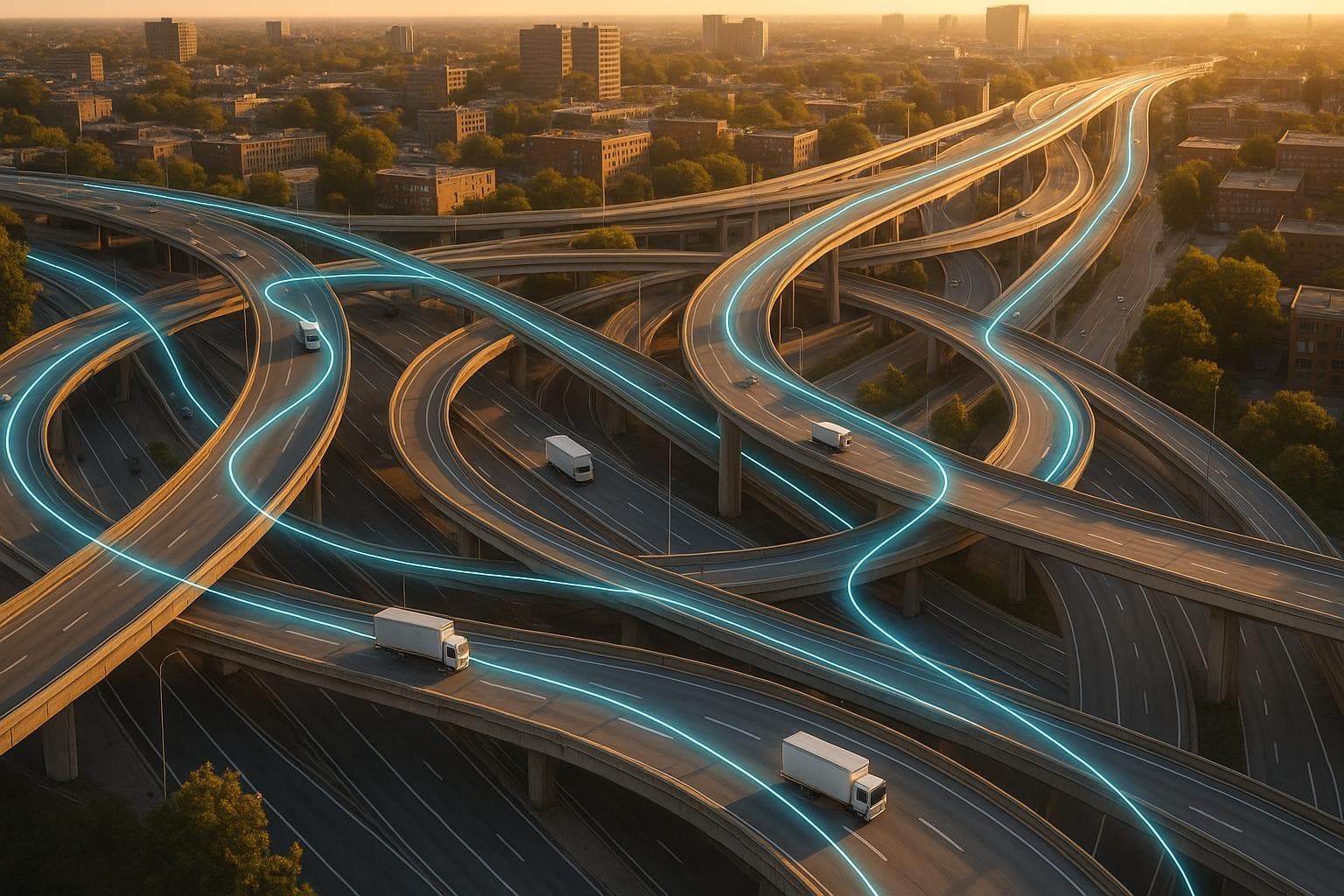
AI Route Optimization: Case Studies in Energy Savings
AI is transforming logistics by optimizing routes to save fuel, reduce costs, and cut emissions. Companies like UPS and public transit agencies are using AI to streamline operations, achieving:
- Fuel savings: Up to 30% reduction in consumption.
- Cost reductions: Millions saved annually.
- Lower emissions: Up to 30% fewer carbon emissions.
- Improved efficiency: Faster deliveries and fewer delays.
Key methods include real-time traffic analysis, predictive maintenance, and machine learning for route planning. These technologies adapt to changing conditions, ensuring smarter, more efficient transportation systems.
Quick Overview
- Public Transit: 12% less fuel used, saving $1.75M annually.
- Utility Fleets: 16% fuel reduction, $511K saved per 100 crews yearly.
- Last-Mile Delivery: 18% drop in fuel use, 25% faster deliveries.
AI isn't just cutting costs - it's reshaping how fleets operate, making logistics smarter and more efficient.
Case Study: AI-Driven Public Transportation Efficiency
Reducing Fuel and Energy Use in Municipal Fleets
Public transit agencies in the United States are finding ways to save energy while improving the quality of their services. Unlike private delivery companies, which focus on getting packages from point A to point B, public transit systems face unique hurdles. They must stick to fixed routes, follow strict schedules, and ensure coverage for all areas they serve.
One major U.S. transit agency turned to AI for route optimization, achieving impressive results: a 10% drop in daily bus mileage and a 12% annual reduction in fuel use. These changes saved about 500,000 gallons of diesel fuel each year and cut over 5,000 metric tons of CO₂ emissions annually. On top of that, on-time performance jumped by 15%.
How did AI make this happen? The system streamlined stop sequences and timing, reducing the time buses spent idling. It also mapped out more efficient routes between stops, cutting down on unnecessary miles.
The financial savings were just as striking. With diesel prices averaging $3.50 per gallon, the reduced fuel consumption saved the agency approximately $1.75 million annually. Combined with lower mileage and better vehicle use, overall operational costs fell by 10–15% each year.
These results highlight the transformative role of AI in public transit and set the stage for a deeper dive into the specific techniques used.
AI Methods Used in Public Transit Optimization
The success of this transit system hinged on four key AI methods, all working together to improve energy efficiency:
- Adaptive Scheduling Algorithms: These algorithms adjusted bus departure and arrival times in real-time, moving away from rigid schedules.
- Real-Time Traffic Analysis: By analyzing live data from city sensors, GPS trackers, and third-party sources, the system identified congestion and rerouted buses to avoid delays and reduce idling.
- Predictive Maintenance Models: Using data from vehicle sensors, the AI predicted potential mechanical issues, allowing maintenance teams to act before breakdowns occurred.
- Machine Learning for Demand Forecasting: By studying historical ridership trends and real-time passenger counts, the system fine-tuned service frequency and vehicle deployment to meet actual demand.
These methods created a continuous feedback loop. Data from daily operations helped the AI refine its understanding of traffic patterns, ridership behaviors, and vehicle performance. The ability to process multiple data streams at once allowed for real-time adjustments, tailored specifically to the needs of public transit.
Before and After Results
Before implementing AI, the transit agency's fleet of 500 buses consumed 4.2 million gallons of diesel annually and covered 12 million miles. The table below shows the dramatic improvements after AI adoption:
| Metric | Before AI | After AI | Improvement |
|---|---|---|---|
| Annual Fuel Consumption | 4.2 million gallons | 3.7 million gallons | 12% reduction |
| Total Miles Driven | 12 million miles | 10.8 million miles | 10% reduction |
| CO₂ Emissions | 42,000 metric tons | 37,000 metric tons | 5,000 metric tons saved |
| On-Time Performance | 72% | 87% | 15 percentage points |
| Annual Fuel Costs | $14.7 million | $12.95 million | $1.75 million saved |
The system also slashed average idle time per bus from 45 minutes to 32 minutes daily, a 29% drop in wasted time and fuel. By predicting and avoiding traffic bottlenecks, buses spent more time moving and less time idling with engines running.
This case study demonstrates how AI can significantly cut fuel use, improve operational efficiency, and lower costs. It offers a clear path for other transit agencies looking to modernize their systems and reduce energy consumption.
Case Study: AI in Utility Fleet Routing During Outage Response
Problems with Standard Utility Fleet Routing
Utility fleets face significant challenges when responding to outages, especially during emergencies like storms. While AI offers opportunities to cut fuel use and emissions, traditional dispatch methods often fall short, leading to inefficiencies that waste both time and resources.
Conventional routing relies heavily on manual decisions. Dispatchers work with limited real-time data, using basic outage reports and their knowledge of crew locations. This lack of visibility into critical factors - like traffic conditions, weather changes, or the severity of outages - results in crews taking inefficient routes, getting stuck in traffic, or revisiting the same sites. The outcome? Wasted fuel, extended response times, and higher operational costs.
These problems worsen during major storm events. With dozens of crews to manage and outages piling up faster than they can be addressed, dispatchers struggle to keep up. Vehicles cover longer distances, idle unnecessarily, and crews spend more time waiting for updated instructions. This not only increases diesel consumption and emissions but also racks up overtime pay, further straining budgets. Clearly, traditional methods are no match for the complexities of modern outage response, highlighting the need for real-time, AI-driven solutions.
AI Solutions for Better Utility Fleet Management
AI-powered routing systems revolutionize how utility fleets operate by processing multiple data streams simultaneously. These systems integrate GPS tracking, live traffic updates, weather forecasts, and real-time outage reports from customers and sensors to optimize crew assignments and routes.
When a new outage is reported, the AI evaluates crew locations, skill sets, and available equipment to assign the most suitable team. It factors in distance, current traffic, weather hazards, and workload to calculate the fastest and most efficient response. This dynamic approach ensures no time or fuel is wasted.
AI also goes a step further by analyzing historical data and real-time inputs to predict where outages are likely to occur. By positioning crews in high-risk areas before an outage even happens, companies can slash response times and fuel use when issues arise.
The system adapts in real time as conditions evolve. If a crew faces delays or a new high-priority outage is reported, the AI recalculates optimal routes for all active teams. Over time, machine learning algorithms refine the system's performance by analyzing data on travel times, crew productivity, and repair durations. This constant learning improves accuracy and efficiency, making the system smarter with each use.
Standard vs. AI-Optimized Dispatch Comparison
Switching from traditional dispatch to AI-optimized routing delivers significant results. The table below compares key metrics to illustrate the benefits of AI-driven fleet management.
| Metric | Standard Dispatch | AI-Optimized Dispatch | Improvement |
|---|---|---|---|
| Average Response Time | 85 minutes | 64 minutes | 25% faster |
| Daily Miles per Crew | 180 miles | 153 miles | 15% reduction |
| Fuel Consumption | 25 gallons/day/crew | 21 gallons/day/crew | 16% reduction |
| Outages per Crew/Day | 4.2 outages | 5.3 outages | 26% increase |
| Daily Fuel Cost per Crew | $87.50 | $73.50 | $14.00 saved |
| Overtime Hours | 12% of total hours | 7% of total hours | 42% reduction |
These improvements add up to substantial savings. For example, a utility company with 100 field crews can save approximately $511,000 annually in fuel costs alone, based on $14.00 in daily savings per crew. When factoring in reduced overtime, better crew productivity, and quicker outage resolution, total annual savings often exceed $2 million.
The environmental impact is also notable. A 16% reduction in fuel consumption means each crew uses 1,460 fewer gallons of diesel annually. For a fleet of 100 crews, this equates to saving 146,000 gallons of fuel and preventing around 1,460 metric tons of CO₂ emissions each year.
Beyond financial and environmental gains, AI optimization significantly enhances customer satisfaction. Faster response times - 25% quicker on average - mean shorter outages for customers, reducing the likelihood of regulatory penalties and strengthening the utility's reputation for dependable service.
These outcomes show how AI can transform utility fleet operations, turning outdated, inefficient processes into streamlined systems that improve efficiency, cut costs, and reduce environmental impact.
Case Study: AI Optimization in Retail and Last-Mile Logistics
AI in Last-Mile Delivery: A Game-Changer
Last-mile delivery is often the most challenging and expensive part of the shipping process, accounting for more than half of total shipping costs. Unlike public transit systems or utility fleets, last-mile logistics involve a maze of high-density stops and intricate routes. Drivers typically manage 120–140 stops each day, navigating unpredictable traffic and tight delivery schedules. With hundreds of thousands of potential route combinations, manual planning simply can't keep up.
This is where AI steps in, turning logistical chaos into organized efficiency by analyzing real-time data. These systems factor in customer details, traffic patterns, weather conditions, and historical performance to calculate the best possible routes - decisions that would be impossible to make manually. And when the unexpected happens, like a sudden road closure or traffic jam, AI systems adapt instantly, recalculating routes on the fly.
But AI's capabilities go beyond just finding the shortest path. It considers delivery time windows, vehicle load capacities, driver expertise, and even fuel efficiency to design routes that save time while maximizing the number of deliveries. The result? Lower fuel consumption, reduced operational costs, and happier customers thanks to faster, more reliable deliveries. This level of optimization not only cuts costs but also sets the stage for substantial energy savings in last-mile logistics.
Energy and Cost Savings Achieved
The impact of AI on logistics is measurable and impressive. Take UPS's ORION (On-Road Integrated Optimization and Navigation) system as an example. By optimizing 55,000 routes, UPS has achieved remarkable results: saving over 10 million gallons of fuel annually, cutting 100,000 metric tons of carbon emissions each year, and avoiding costs of $300–$400 million annually. Even small changes add up - reducing just one mile per driver per day saved UPS up to $50 million annually. Overall, the system has cut delivery miles by 100 million per year and now optimizes routes for 125,000 vehicles daily, with 97% of UPS vans relying on the technology.
Other companies have seen similar benefits. One logistics provider reported a 40% reduction in delivery times and saved $500,000 annually after implementing AI-powered route optimization between 2024 and 2025. Industry data from 2025 highlights even broader trends: AI route optimization has led to an 18% drop in fuel consumption, a 25% improvement in on-time deliveries, and a 30% reduction in carbon emissions. For UPS, reducing delivery miles by 100 million directly translates to fewer greenhouse gas emissions - equivalent to taking thousands of vehicles off the road. This not only supports sustainability goals but also strengthens the bottom line.
Integration with Real-Time Data Sources
AI systems thrive on real-time data, enabling them to make split-second decisions that keep deliveries on track. These systems continuously process GPS data, live traffic updates, weather forecasts, road closures, delivery time windows, and vehicle load capacities to optimize routes throughout the day.
The real magic lies in their adaptability. If traffic suddenly backs up or weather conditions change, the system instantly reroutes vehicles to avoid delays, ensuring deliveries stay on schedule with minimal fuel waste. When a high-priority delivery pops up, the AI recalculates routes for all active vehicles to accommodate it seamlessly.
UPS's ORION system is a prime example of how AI can deliver counterintuitive but effective solutions. The system learns from every completed delivery, using machine learning algorithms to refine its predictive models. By analyzing billions of data points daily, it identifies patterns and optimizations that would be impossible to uncover manually.
For large-scale operations like UPS, successful integration requires connecting AI with existing fleet management systems while providing drivers with real-time insights. These systems handle massive amounts of data and deliver actionable recommendations to thousands of drivers simultaneously. By integrating with transportation management systems, GPS platforms, and warehouse management tools, AI ensures smooth operations without disrupting established workflows.
These examples underscore AI's ability to transform logistics, delivering efficiency gains and reducing emissions in ways that benefit both businesses and the environment.
sbb-itb-1c5debd
Comparison of AI Methods and Results
Key AI Methods Across Case Studies
In logistics, three standout AI approaches consistently deliver measurable energy savings. Reinforcement learning shines when balancing multiple goals like fuel efficiency, delivery schedules, vehicle capacity, and driver feedback. This makes it perfect for operations with vast route variations, sometimes numbering in the hundreds of thousands. Predictive analytics steps in to forecast optimal departure times and flag potential delays by analyzing both historical trends and real-time data. This helps companies sidestep traffic congestion and weather-related disruptions. Lastly, dynamic rerouting excels in adapting to unexpected changes, instantly recalculating routes for entire fleets when faced with traffic jams, road closures, or urgent delivery needs.
When these methods are combined, their impact grows exponentially. Systems that integrate reinforcement learning for optimization, predictive analytics for scheduling, and dynamic rerouting for real-time decisions explain why advanced AI applications deliver such outstanding results across industries. Together, they consistently improve energy use and streamline operations, as highlighted in the table below.
Results Summary Table
The table below compares key case studies, using standardized metrics to showcase the impact of AI-driven solutions on fuel savings, costs, emissions, and delivery efficiency:
| Case Study | Annual Fuel Saved | Cost Savings (USD) | CO₂ Reduced (metric tons) | Delivery Efficiency |
|---|---|---|---|---|
| UPS ORION | 10+ million gallons | $50+ million | 100,000+ | 8 miles reduced per driver |
| 2025 AI Systems | 18% reduction | Varies by scale | 30% decrease | 25% faster deliveries |
| Cement Manufacturer | 500,000+ gallons | $2+ million | Significant reduction | 30% faster operations |
| Retail Last-Mile | 250,000+ gallons | $500,000+ | 30% reduction | 25% faster deliveries |
Across these examples, fuel savings consistently range from 15% to 30%, with the 2025 systems achieving an 18% improvement compared to previous years. Carbon emissions reductions are equally impactful, with most systems cutting greenhouse gas output by 30%.
Delivery efficiency also plays a crucial role in these savings. Reducing delivery miles by millions annually leads to fewer vehicle hours on the road, less idling, and reduced equipment wear. Additionally, optimizing customer clusters helps minimize total travel distances, further boosting efficiency.
Requirements for Successful Implementation
To unlock these benefits, companies need to meet several key requirements:
- Real-time data integration: Incorporating GPS, traffic updates, weather conditions, and historical performance data is critical for AI systems to function effectively.
- Organizational readiness: Proper training and executive support are vital, especially when AI systems suggest counterintuitive changes.
- Compliance with regulations: Adhering to Department of Transportation (DOT) rules and emissions standards while optimizing routes across varying local policies is non-negotiable.
The most successful implementations ensure AI systems integrate smoothly with existing tools like transportation management systems, GPS platforms, and warehouse management software. This approach avoids the need for a complete operational overhaul, enabling quicker adoption and more impactful results.
For companies exploring AI-driven route optimization, SupplyChainBriefing offers weekly summaries of the latest research in supply chain management. These summaries turn complex academic insights into actionable strategies, helping organizations stay informed and make smarter implementation decisions.
Conclusion: Lessons Learned and Future Directions
Key Business Takeaways
AI-powered route optimization has become a game-changer for logistics providers in the U.S., offering both operational efficiency and significant cost savings. By implementing these systems, companies have achieved fuel reductions of 15–30% and saved millions annually. For example, top-tier solutions have slashed delivery miles and carbon emissions, while also cutting costs by hundreds of thousands of dollars each year.
The most effective implementations share three core features: seamless integration with existing systems, the ability to learn and adapt over time, and transparency through explainable AI. Businesses that emphasize these elements see ongoing improvements as the AI refines its models with each delivery and adjusts to real-time conditions. This iterative process explains why early adopters often gain a 35% edge over competitors who delay adoption.
The benefits aren’t limited to cost savings. AI systems have also proven to be powerful tools for reducing environmental impact. In one study, these technologies lowered carbon emissions by 30%, helping companies comply with stricter regulations while also enhancing customer satisfaction through more reliable and timely deliveries.
Looking ahead, new trends promise to reshape the industry even further.
New Trends in AI and Energy Efficiency
Emerging technologies like multi-agent AI systems are poised to revolutionize fleet coordination. By managing entire fleets in real time, rather than optimizing individual routes, these systems offer even greater efficiency gains.
Predictive analytics is also advancing rapidly, with IoT sensors and smart infrastructure playing a key role. These technologies enhance multi-modal operations, paving the way for additional energy and cost savings while bolstering supply chain resilience.
Machine learning algorithms are becoming increasingly sophisticated, incorporating driver feedback and real-world performance data to create self-improving supply chains. These systems can even uncover unexpected optimizations - like UPS’s well-known practice of favoring right-hand turns to cut idling time and reduce accident risks. Such insights highlight the potential for AI to rethink logistics in ways humans might not anticipate.
Current Challenges and Opportunities
While the benefits of AI are clear, implementing these advancements comes with its own set of challenges. Scaling AI solutions across diverse logistics operations can be tricky, especially when it involves integrating data from multiple systems like transportation management platforms, GPS tools, and warehouse software. Ensuring workforce buy-in is another hurdle, particularly when AI recommendations seem counterintuitive.
The fast pace of AI innovation can also leave teams feeling overwhelmed, making it difficult to stay current with new technologies and identify promising pilot projects. Yet, these challenges bring unique opportunities. Companies that can effectively translate AI research into actionable strategies will be well-positioned to adopt breakthrough technologies ahead of competitors. Areas like multi-modal transportation, smart infrastructure, and collaborative AI platforms remain largely untapped but hold immense potential for energy savings and operational improvements.
For U.S. businesses navigating this dynamic landscape, staying informed is critical. Resources like SupplyChainBriefing offer practical solutions by distilling complex AI research into actionable insights. Their weekly summaries help organizations craft strategic roadmaps and identify emerging technologies without getting bogged down by academic jargon.
"I can finally answer 'What about AI?' with confidence." - VP Supply Chain, Fortune 500 retailer
"Found 3 viable pilots in one month of reading SupplyChainBriefing." - CTO, logistics company
The takeaway is clear: companies that embrace AI innovations and refine their strategies early will secure a lasting competitive edge.
Rising Fuel Costs? Cut Transport Costs by 20% with AI Route Optimization
FAQs
How does AI-powered route optimization help reduce carbon emissions in logistics?
AI-driven route optimization plays a key role in cutting carbon emissions within the logistics industry. By pinpointing the most efficient delivery routes, it helps reduce fuel usage and eliminates unnecessary mileage. Through analyzing factors like traffic patterns, delivery schedules, and vehicle capacities, AI ensures resources are used in a smarter way, resulting in fewer emissions for each trip.
What’s more, AI can adjust routes in real-time to account for unexpected changes, like traffic jams or bad weather. This flexibility not only boosts efficiency but also lessens the environmental impact. Alongside lowering emissions, these improvements translate to reduced fuel expenses and faster delivery times for companies.
What challenges do companies face when adopting AI-powered route optimization, and how can they address them?
Companies face a variety of hurdles when rolling out AI-powered route optimization systems. One major issue is data quality and availability. These systems rely on precise, up-to-date information about routes, traffic patterns, and delivery schedules. However, this data isn’t always easy to access or well-organized. To tackle this, investing in strong data collection and management processes is key. Reliable data is the foundation for any AI tool to perform effectively.
Another common obstacle is integration with existing systems. Many companies still rely on legacy software or outdated infrastructure, which can complicate the adoption of modern AI solutions. The best way to navigate this is by partnering with vendors who offer flexible, scalable systems that can easily align with current operations.
Lastly, there’s the challenge of employee training and adoption. Staff members may be unfamiliar with AI tools or hesitant to embrace new technology. To ease this transition, businesses should provide thorough training and clearly illustrate the benefits of AI - like cutting down fuel costs and speeding up delivery times. Showing how these tools make their jobs easier can go a long way in gaining employee support.
How do AI systems adjust for real-time traffic or weather changes to optimize routes effectively?
AI-driven route optimization tools tap into real-time data from sources like traffic updates, weather forecasts, and GPS systems to adjust routes on the fly. They analyze live conditions and anticipate possible delays, helping drivers stick to the quickest and most efficient paths.
By processing this constant stream of information, AI can redirect vehicles to steer clear of traffic congestion, roadblocks, or extreme weather. The result? Shorter delivery times, lower fuel consumption, and streamlined logistics operations that save both time and energy.